
On July 9, 2026, OpenAI put ChatGPT Sites into public beta. You describe a website in chat, ChatGPT builds it, hosts it, and hands you a live URL. No deployment step, no hosting account, no developer.
Which means the bottleneck moved. It is no longer whether you can get a website built. It is whether the thing that comes out is a brochure nobody calls, or a page that actually turns a worried homeowner into a booked job. That difference lives almost entirely in the prompt you paste in.
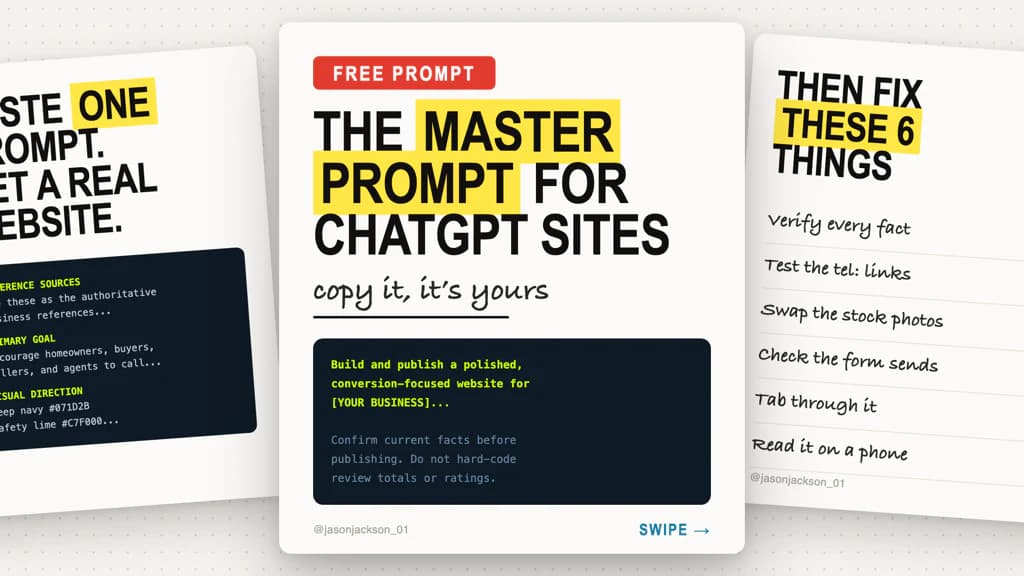
So we are giving ours away. Below is the complete master prompt we use to build local service websites, the real one, unedited, including the worked example we built it against. Copy it, adapt it, run it. No email gate, no signup.
Two prompts follow. The first is the full working version written for a real radon company, useful because you can see exactly how specific the instructions get. The second is the same prompt stripped to fill-in-the-blank fields for your own business.
What Actually Changed With ChatGPT Sites
ChatGPT could already write HTML. What it could not do was put that HTML somewhere a customer could reach. Sites closes that gap: it generates the code, versions it, hosts it, and serves it at a public URL from inside the chat window. You can trigger it by describing what you want, or by calling it directly in your message.
As of the July 2026 beta, Sites is rolling out to paid plans, Pro, Pro Lite, and Edu first, with Plus following, and it is not on the Free or Go tiers. Public publishing was also held back in the EEA, Switzerland, and the UK at launch. Availability is moving quickly, so check your own account rather than trusting a date on a blog post.
Treat Sites as a fast way to get a real page in front of real customers, not as your permanent home. Hosting you do not control is fine for a launch, a campaign page, or a proof of concept. For a business you intend to rank, plan on a domain you own. More on that below.
Why Short Prompts Produce Forgettable Sites
Ask any AI builder for a website for my radon company and you will get something that looks fine and converts nothing. Soft blue gradient, a stock photo of a house, three feature cards with generic icons, a contact form, and copy that could belong to any of four hundred companies in the same trade.
That is not the model failing. That is the model filling in every decision you declined to make. A short prompt hands over all of the following:
- Who the page is talking to. A homeowner who just got a scary test result and a real-estate agent with a closing in nine days need different first sentences.
- What the single desired action is. Every section either moves someone toward the phone call or wastes their attention.
- Which facts are real. Left unguided, models will happily invent a review count, a certification, a price range, or a year founded.
- What the brand looks like. Without named hex values and type direction you get the default palette every AI site is currently shipping with.
- What good enough means. Accessibility, contrast, mobile behavior, and structured data do not appear unless you ask for them by name.
A master prompt is just the discipline of making those decisions up front, once, in writing. It is long on purpose.
The Anatomy of a Master Prompt
Every block in the prompt below is doing a specific job. If you are adapting this for a different trade, keep the structure and swap the contents.
| Block | What it controls | What breaks without it |
|---|---|---|
| Reference sources | Where the model gets its facts | Invented details, wrong phone number, stale service area |
| Fact-verification rule | An explicit ban on hard-coding unverified numbers | A fabricated review count sitting on your homepage |
| Primary goal | The one action every section serves | Pretty pages that never ask for the call |
| Visual direction | Named hex values, type, spacing, imagery rules | Default AI aesthetic, indistinguishable from competitors |
| Site structure | Sections in order, with the messaging for each | Missing trust signals, buried phone number |
| Questions section | Real objections answered before the call | Thin content with nothing for AI systems to cite |
| Location and map | Proximity proof and directions | No local signal at all |
| SEO requirements | Titles, headings, schema, alt text | A site search engines cannot categorize |
| Quality requirements | Accessibility, contrast, responsiveness, no overflow | Broken mobile layout, unusable by keyboard |
| Pre-publish checklist | The model checks its own work | Dead links, missing logo, placeholder text going live |
The fact-verification rule is the one people skip, and it is the one that matters most. Any number that changes on its own, review totals, star ratings, hours, prices, is a liability the moment it is baked into a static page. Tell the model to link to the live source instead of copying the number.
The Full Master Prompt
This is the working version, written for Air Sense Environmental, a licensed radon testing and mitigation company in the St. Louis metro. We are publishing it with the real business details intact because the specificity is the lesson. Vague prompts get vague sites.
Master prompt: local service website
1,195 words · paste straight into ChatGPT
Build and publish a polished, conversion-focused website for Air Sense Environmental, a certified radon testing and mitigation company serving the greater St. Louis region.

REFERENCE SOURCES

Use these as the authoritative business references:

- Main website: https://airsenseenvironmental.com/
- Google Business Profile, reviews, and directions: https://share.google/uOOjSOYQvmA17d2vE
- Business address: 5237 Old Alton Edwardsville Rd, Edwardsville, IL 62025
- Phone: 314-664-9807
- IEMA license: #RNM20232346
- Service area: Greater St. Louis, including communities on the Missouri and Illinois sides of the metro

Confirm current facts before publishing. Do not hard-code review totals, ratings, hours, prices, certifications, or service areas unless they have been verified recently.

PRIMARY GOAL

Encourage homeowners, buyers, sellers, real-estate professionals, and property managers to call Air Sense Environmental or request a free consultation for radon testing or mitigation.

The website should immediately communicate:

- Radon is invisible and requires testing.
- Air Sense is a qualified local expert.
- Testing and mitigation are straightforward.
- The company provides clear explanations and verifiable results.
- Customers consistently describe the team as professional, responsive, clean, friendly, and efficient.

VISUAL DIRECTION

Create a bold, high-trust environmental-services design.

Use:

- Deep navy: approximately #071D2B
- Near-black navy: approximately #03131D
- Safety lime: approximately #C7F000
- Warm white: approximately #F7F5EF
- Supporting slate and cool-gray tones
- Strong condensed typography for major headings
- Clean sans-serif typography for body copy and navigation
- Squared or lightly rounded buttons
- Generous spacing and strong contrast
- Subtle technical details inspired by airflow, measurements, and radon systems

The hero should use a professional residential radon-mitigation image with a diagonal or structured crop. Avoid generic stock photography, frightening imagery, excessive gradients, and fear-based messaging.

BRANDING

Display the Air Sense Environmental logo prominently in the header and footer.

The logo should link to https://airsenseenvironmental.com/

Also include a clearly labeled "Main website" link elsewhere in the navigation or contact area.

SITE STRUCTURE

1. Header

Include:

- Air Sense Environmental logo
- Services
- Our Process
- Reviews
- Radon Questions
- Phone number
- Free Consultation button
- Main Website link

2. Hero

Suggested messaging:

Eyebrow: "Radon protection, done right"

Headline: "Breathe easier. Live safer."

Supporting copy: "Certified radon testing and mitigation for St. Louis homes. Clear answers, precise installation, and results you can verify."

Primary CTA: "Schedule a free consultation"

Secondary CTA: 314-664-9807

3. Trust Bar

Feature verified trust signals such as:

- IEMA licensed
- NRPP certified
- Current Google rating and review total
- Greater St. Louis service area
- Post-installation verification

Use the latest verified review count instead of an outdated static number.

4. Why Radon Matters

Explain that radon:

- Is naturally occurring
- Cannot be seen, smelled, or tasted
- Can enter through foundation cracks, sump pits, crawl spaces, and utility openings
- Is only detectable through testing
- Should be addressed at or above the EPA action level of 4.0 pCi/L
- May warrant consideration between 2.0 and 4.0 pCi/L

Keep the language clear, factual, and calm.

5. Services

Include cards for:

- Radon testing
- Residential radon mitigation
- Commercial radon mitigation
- Indoor air-quality testing
- Crawl-space encapsulation

Each service should include a short explanation and a clear next step.

6. Process

Explain the process in three steps:

Test: Professionally measure the home and explain the result.

Design: Plan the correct suction points, fan, pipe route, sealing work, and system configuration.

Verify: Perform post-installation testing and confirm that the system is reducing radon properly.

7. Google Reviews

Create an attractive review section using current, authentic Google feedback.

Include:

- Current verified Google rating
- Current review count
- Several recent representative reviews
- Reviewer name and review date
- Five-star indicators
- A prominent "View all Google reviews" link using https://share.google/uOOjSOYQvmA17d2vE
- A "Leave a review" action when the correct destination is available

Do not fabricate, rewrite, or misattribute reviews. Avoid copying all reviews into static code because the collection changes. Display representative recent reviews and connect visitors to the complete live Google collection.

8. St. Louis Radon Questions

Research current questions homeowners ask about radon in the St. Louis and Missouri market. Cover at least:

- How common is elevated radon in Missouri?
- Can neighboring homes have different radon levels?
- What radon level requires action?
- Which level of the home should be tested?
- Can windows be opened during a short-term test?
- Should buyers and sellers order a new radon test?
- When should a home be retested?
- How much does mitigation typically cost?
- How long does installation take?
- Will the system be visible or noisy?
- How are sump pits and crawl spaces handled?
- How do homeowners know the system is working?
- What happens if the post-mitigation result is still high?
- Does a mitigation system require maintenance?

Ground health and testing answers in current EPA and Missouri Department of Health guidance. Avoid unsupported medical claims, absolute guarantees, or invented pricing.

Use expandable, keyboard-accessible FAQ controls. Add FAQ structured data when appropriate and when the visible page content exactly matches the structured data.

9. Location and Google Map

Embed a Google map for 5237 Old Alton Edwardsville Rd, Edwardsville, IL 62025

Include:

- Business name
- Address
- Greater St. Louis service-area explanation
- "Open in Google Maps" link
- Phone number
- Directions link

Lazy-load the map and give the iframe an accessible title.

10. Final CTA

Use a strong closing section: "Ready to breathe with confidence?"

Include:

- Call 314-664-9807
- Free consultation
- Link to airsenseenvironmental.com
- Link to Google reviews or directions

11. Footer

Include:

- Logo
- Phone number
- Address
- Main website
- Google profile
- Core services
- Service-area summary
- Current copyright year

SEO REQUIREMENTS

Target natural variations of:

- Radon mitigation St. Louis
- Radon testing St. Louis
- Radon mitigation near me
- Radon mitigation Edwardsville IL
- St. Louis radon company
- Radon system installation
- Residential radon testing
- Commercial radon mitigation
- Crawl-space radon mitigation

Write for people first. Do not stuff keywords or create repetitive location copy.

Include:

- Descriptive title and meta description
- Proper heading hierarchy
- LocalBusiness or relevant service-business structured data
- FAQ structured data when valid
- Descriptive image alt text
- Strong internal section navigation
- Links to authoritative EPA and Missouri resources where helpful

QUALITY REQUIREMENTS

The finished site must be:

- Responsive on desktop, tablet, and mobile
- Fast-loading
- Keyboard accessible
- Touch-friendly
- High contrast
- Screen-reader friendly
- Free from horizontal overflow
- Respectful of reduced-motion preferences
- Built with semantic HTML
- Clear about which links leave the site
- Free from broken links, missing images, console errors, and placeholder content

Preserve the established navy-and-lime visual identity when updating an existing build.

Before publishing:

- Confirm the logo renders correctly.
- Confirm every phone link uses tel:+13146649807.
- Confirm the Google review link works.
- Confirm the map loads correctly.
- Confirm FAQ controls expand and collapse.
- Confirm current review totals and business facts.
- Test desktop and mobile layouts.
- Run the production build.
- Publish the verified production version and return its live URL.
The Fill-in-the-Blank Version
Same skeleton, your business. Replace everything in square brackets and delete any block that does not apply to your trade. The instruction lines outside the brackets are doing real work, so resist the urge to trim them.
Master prompt: fill-in-the-blank template
761 words · paste straight into ChatGPT
Build and publish a polished, conversion-focused website for [BUSINESS NAME], a [LICENSE OR CERTIFICATION] [TRADE OR SERVICE TYPE] company serving [PRIMARY SERVICE AREA].

REFERENCE SOURCES

Use these as the authoritative business references:

- Main website: [URL]
- Google Business Profile, reviews, and directions: [GOOGLE PROFILE SHARE LINK]
- Business address: [FULL STREET ADDRESS]
- Phone: [PHONE]
- License or certification numbers: [LICENSE NUMBERS]
- Service area: [CITIES, COUNTIES, OR RADIUS]

Confirm current facts before publishing. Do not hard-code review totals, ratings, hours, prices, certifications, or service areas unless they have been verified recently.

PRIMARY GOAL

Encourage [AUDIENCE 1], [AUDIENCE 2], and [AUDIENCE 3] to call [BUSINESS NAME] or request [YOUR OFFER, e.g. a free estimate].

The website should immediately communicate:

- [THE PROBLEM THE CUSTOMER HAS]
- [WHY THIS COMPANY IS QUALIFIED TO SOLVE IT]
- [WHY THE PROCESS IS EASIER THAN THEY FEAR]
- [WHAT PROOF THE CUSTOMER GETS AT THE END]
- [THE THEME THAT SHOWS UP REPEATEDLY IN YOUR REVIEWS]

VISUAL DIRECTION

Create a [ADJECTIVE, e.g. bold, high-trust] [INDUSTRY] design.

Use:

- Primary color: [HEX]
- Dark neutral: [HEX]
- Accent color: [HEX]
- Light background: [HEX]
- Supporting neutral tones
- [HEADING TYPE DIRECTION]
- Clean sans-serif typography for body copy and navigation
- [BUTTON STYLE]
- Generous spacing and strong contrast
- Subtle details inspired by [SOMETHING FROM YOUR ACTUAL TRADE]

The hero should use [DESCRIBE THE REAL PHOTO YOU WILL SUPPLY]. Avoid generic stock photography, frightening imagery, excessive gradients, and fear-based messaging.

BRANDING

Display the [BUSINESS NAME] logo prominently in the header and footer, linked to [URL]. Also include a clearly labeled "Main website" link in the navigation or contact area.

SITE STRUCTURE

1. Header: logo, [NAV ITEM], [NAV ITEM], [NAV ITEM], phone number, [CTA BUTTON LABEL], main website link.

2. Hero:
   Eyebrow: "[SHORT POSITIONING LINE]"
   Headline: "[BENEFIT IN PLAIN LANGUAGE]"
   Supporting copy: "[ONE SENTENCE ON WHAT YOU DO, FOR WHOM, AND THE PROOF THEY GET]"
   Primary CTA: "[ACTION]"
   Secondary CTA: [PHONE]

3. Trust bar: [LICENSE], [CERTIFICATION], current Google rating and review total, [SERVICE AREA], [YOUR VERIFICATION STEP]. Use the latest verified review count instead of an outdated static number.

4. Why this matters: explain the underlying problem in clear, factual, calm language. Cite [AUTHORITATIVE SOURCE] for any standard, threshold, or health claim.

5. Services: cards for [SERVICE 1] through [SERVICE 5]. Each includes a short explanation and a clear next step.

6. Process: three steps, [STEP 1 NAME], [STEP 2 NAME], [STEP 3 NAME], each with one sentence on what actually happens.

7. Reviews: current verified rating, current review count, several recent representative reviews with reviewer name and date, star indicators, a prominent "View all Google reviews" link using [GOOGLE PROFILE SHARE LINK], and a "Leave a review" action. Do not fabricate, rewrite, or misattribute reviews. Do not copy the entire review collection into static code, because it changes.

8. Questions: research the questions [YOUR CUSTOMERS] actually ask in [YOUR MARKET]. Cover at least [QUESTION 1] through [QUESTION 10]. Ground answers in [AUTHORITATIVE SOURCE]. Avoid unsupported claims, absolute guarantees, and invented pricing. Use expandable, keyboard-accessible FAQ controls, and add FAQ structured data only when the visible content exactly matches it.

9. Location: embed a lazy-loaded, accessibly titled map for [ADDRESS], with business name, address, service-area explanation, "Open in Google Maps" link, phone, and directions link.

10. Final CTA: "[CLOSING QUESTION]" with call, [OFFER], main website link, and reviews or directions link.

11. Footer: logo, phone, address, main website, Google profile, core services, service-area summary, current copyright year.

SEO REQUIREMENTS

Target natural variations of [KEYWORD 1] through [KEYWORD 8]. Write for people first. Do not stuff keywords or create repetitive location copy.

Include a descriptive title and meta description, proper heading hierarchy, LocalBusiness or relevant service-business structured data, FAQ structured data when valid, descriptive image alt text, strong internal section navigation, and links to authoritative resources where helpful.

QUALITY REQUIREMENTS

The finished site must be responsive on desktop, tablet, and mobile; fast-loading; keyboard accessible; touch-friendly; high contrast; screen-reader friendly; free from horizontal overflow; respectful of reduced-motion preferences; built with semantic HTML; clear about which links leave the site; and free from broken links, missing images, console errors, and placeholder content.

Before publishing:

- Confirm the logo renders correctly.
- Confirm every phone link uses tel:+[E164 PHONE].
- Confirm the review link works.
- Confirm the map loads correctly.
- Confirm FAQ controls expand and collapse.
- Confirm current review totals and business facts.
- Test desktop and mobile layouts.
- Run the production build.
- Publish the verified production version and return its live URL.
How to Run It
- Open ChatGPT on a plan that includes Sites and start a new chat.
- Paste the filled-in prompt as your first message. Do not warm up with small talk first, the prompt is designed to be the opening instruction.
- Let it build the whole thing before you critique anything. Interrupting mid-build produces a patchwork.
- Review against the pre-publish checklist at the bottom of the prompt, which is why that checklist is in there.
- Give feedback one section at a time. Fix the hero, then the trust bar, then services. Broad notes like make it better undo work you already liked.
- Upload your real logo and real job photos. This is the single biggest quality jump available to you, and no prompt can do it for you.
Keep the prompt in a note somewhere. When you want a second page, a seasonal campaign, or a site for a different location, you are editing a known-good document instead of starting from a blank box.
What to Fix After the First Build
Even with a long prompt, the first build ships with problems. These are the ones we see every time, in the order they cost you money:
- Verify every fact on the page. Ratings, review counts, license numbers, years in business, and service areas. Models fill gaps confidently. You are the one liable for what ends up published.
- Check the phone links on an actual phone. A number that looks right but is not wrapped in a tel: link kills conversions on the device most of your traffic is using.
- Replace the placeholder imagery. Real trucks, real crews, real installations. Stock photos read as a company that has not done the work.
- Confirm the form goes somewhere. AI builders routinely produce forms that validate, submit, animate a thank-you, and deliver nothing to anyone.
- Test with the keyboard alone. Tab through the whole page. If the FAQ controls or the mobile menu cannot be reached or dismissed, they are broken for more people than you think.
- Read it on a phone in daylight. Most local service traffic is mobile, often outdoors, often in a hurry.
Then there is the strategic fix, which is the one most people skip: get the site onto a domain you own. A hosted beta URL is fine for testing an offer. It is not a foundation. Links, rankings, and entity signals accrue to a domain, and you cannot move that equity later if the domain was never yours.
A Website Is Not Visibility
Here is the uncomfortable part, and we would rather say it than sell around it. You can run this prompt, get a genuinely excellent website, publish it, and have absolutely nothing happen.
A website is where people land after they have already decided to consider you. It is not the thing that puts you in front of them. For a local service business, the deciding moment happens somewhere else entirely:
- In the Google Map Pack, where three businesses get seen and the rest do not, driven by your Google Business Profile rather than your website.
- In AI answers, where someone asks ChatGPT for a radon company near Edwardsville and gets a handful of names. Whether you are one of them depends on how consistently your business is described across the web, not how nice your hero section looks. That is what answer engine optimization is about.
- In reviews, which are both the ranking signal and the reason someone picks you over the company listed above you.
- In citations and directory consistency, the unglamorous plumbing that tells every system your business is real, is where you say it is, and is called what you say it is called.
A great site makes all of those convert better. None of them happen because a great site exists. If you take one thing from this post beyond the prompt itself, take that.
Good sequence: build the site with the prompt, publish it on your own domain, then fix your Google Business Profile, then work on reviews and citations. Most businesses do exactly one of those four and wonder why the phone is quiet.
Questions About the Master Prompt
Is the prompt really free to use?
Yes. Copy it, edit it, use it for your own business or for clients. No attribution required and no email needed. We would rather be the people who gave you the useful thing.
Do I need ChatGPT Sites specifically?
No. The prompt is a specification, not a Sites feature. It works in any AI builder that can produce a full page, and it works with a human developer too. Sites just removes the hosting step, which is why it prompted this post.
Why is the prompt so long?
Because every decision you leave out is a decision the model makes for you, and its defaults are the same defaults everyone else is getting. Length is not the point, specificity is. The length is a side effect.
Can I use this for a trade other than radon?
That is what the fill-in-the-blank version is for. The structure holds for any local service business where trust and proximity drive the decision: HVAC, roofing, plumbing, pest control, electrical, restoration, inspection. Swap the services, the questions, and the authoritative sources you cite.
Will a site built this way rank on Google?
It gives you a technically sound starting point: clean headings, structured data, fast pages, real answers to real questions. Ranking locally also depends on your Google Business Profile, reviews, citation consistency, and links, none of which live on your website. See the section above on why a website is not visibility.
Should I let AI write the review section from my actual reviews?
Display a few real ones with the reviewer name and date, then link to your live Google profile for the rest. Never let a model rewrite, summarize, or invent reviews, and never hard-code a total that will be wrong next month. The prompt includes that instruction for exactly this reason.
What if I do not have a logo or professional photos yet?
Run the prompt anyway and treat the result as a working draft. Then get photos, even phone photos of real jobs beat stock imagery for a local service business. Real crews and real installations are the fastest credibility upgrade available to you.
Take the Prompt
That is the whole thing, no gate and no catch. If you build something with it, we would genuinely like to see it.
And when you get to the part where the site is live and the phone still is not ringing, that gap between having a website and being the business AI systems and Google actually recommend is the problem we work on. Book a free visibility audit and we will show you where you currently stand.

Written by
Jason JacksonChief Operating Officer, Locafy Limited
COO at Locafy (Nasdaq: LCFY). Builds and operates AEO systems for local businesses. Founded Growth Pro Agency before joining Locafy via acquisition.