
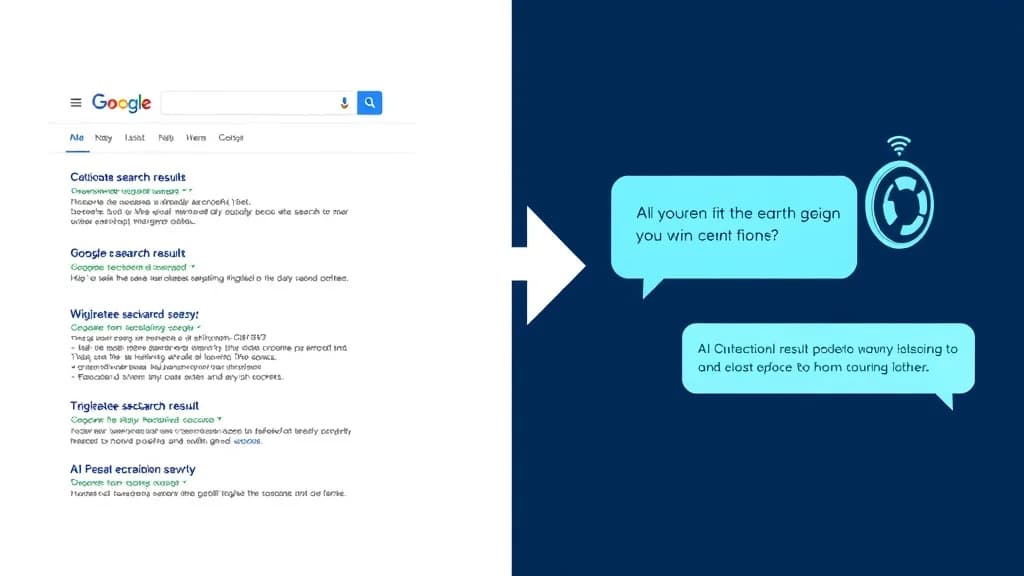
Search is splitting into two channels, and local businesses that only optimize for one are leaving money on the table. Traditional search (Google organic results, local pack, Maps) still drives the majority of local business discovery. But AI search (ChatGPT, Google AI Overviews, Gemini, Perplexity) is growing rapidly and captures the highest-intent queries. Understanding how these channels differ, and where they overlap, is critical for any local business that depends on search-driven revenue.
How Traditional Search Works
Traditional search is a list-based model. A user types a query, the search engine returns a ranked list of web pages (and sometimes ads, map results, and featured snippets), and the user browses the list to find relevant results. The search engine acts as a librarian, it points you to sources but doesn't read them for you. Success in traditional search means ranking as high as possible in this list, which is the domain of SEO.
How AI Search Works
AI search is an answer-based model. A user asks a question, the AI reads dozens of web pages behind the scenes, synthesizes the information, and presents a single, comprehensive answer, sometimes citing sources, sometimes not. The AI acts as a research assistant, it reads the sources for you and gives you its conclusion. Success in AI search means being the source the AI chooses to cite, which is the domain of GEO.
Side-by-Side Comparison
| Dimension | Traditional Search | AI Search |
|---|---|---|
| User experience | Browse a list of links | Read a synthesized answer |
| Discovery model | User clicks through to multiple sites | AI recommends specific businesses by name |
| Traffic model | Click-through to your website | Brand mention + occasional referral click |
| Competitive field | 10 businesses on page 1 | 1-3 businesses named in the answer |
| Optimization discipline | [SEO](/blog/local-seo-guide), keywords, backlinks, technical | [GEO](/blog/generative-engine-optimization-guide), quotability, entity, structure |
| Key ranking signals | Backlinks, relevance, page speed, UX | Source authority, freshness, quotability, entity clarity |
| Measurement | Rankings, organic traffic, CTR | [Citation frequency](/blog/ai-search-visibility), brand mentions, AI referral traffic |
The User Behavior Shift
The most important shift isn't technological, it's behavioral. Users are changing how they search based on the type of question they're asking:
- **Research and recommendation queries** are moving to AI search. "Best dentist in Dallas" is increasingly asked to ChatGPT or Gemini rather than typed into Google.
- **Navigational queries** stay on traditional search. "Yelp login" or "Domino's menu" still go to Google because users want a specific website.
- **Transactional queries** are split. "Buy running shoes" goes to Google or Amazon, but "what running shoes should I buy for flat feet" goes to AI.
- **Local "near me" queries** are contested. Both Google Maps and AI engines compete for these high-value queries, with AI Overviews increasingly appearing above the local pack.
What This Means for Local Businesses
The implication is clear: local businesses need to be visible in both channels. Traditional search still drives the majority of total search volume, but AI search is capturing the highest-intent recommendation queries, the ones that directly generate leads and customers. A business that ranks #1 on Google but is invisible to ChatGPT is losing the customers who ask AI for recommendations. A business that gets cited by ChatGPT but doesn't rank on Google is missing the broader traffic pool.
“Traditional search asks 'which of these links should I click?' AI search asks 'which business should I choose?' The second question is more valuable because the user has already decided to take action, they just need a name.”
Building for Both Channels
The most efficient approach is a dual-optimization strategy that invests in the shared foundation (structured data, GBP optimization, reviews, citations) while adding channel-specific tactics for each surface. The shared foundation covers about 60% of the work and lifts both channels simultaneously. The remaining 40% is split between SEO-specific work (keyword optimization, internal linking, SERP feature targeting) and GEO-specific work (quotability, Bing indexation, AI brand monitoring).
Locafy helps local businesses win in both traditional and AI search. Our Localizer product handles the SEO foundation and the full GEO and AEO layer in one engine, making sure you're visible wherever your customers are searching: Google, ChatGPT, Gemini, Perplexity, or AI Overviews. Book a free strategy call to build your dual-channel plan.
AI Search vs Traditional Search FAQ
Is AI search going to replace traditional search?
Not in the near term. Traditional search will remain important for navigational, transactional, and deep-research queries. However, AI search is rapidly capturing recommendation and informational queries, the ones that are most valuable for local business lead generation. The two channels will coexist, but the balance is shifting toward AI search for high-intent queries. Smart businesses invest in both.
Which AI search platform should I prioritize?
Google AI Overviews has the largest reach because they appear within Google Search. ChatGPT has the fastest-growing user base. Perplexity drives the most referral traffic per citation. Gemini has the deepest Google ecosystem integration. Ideally, optimize for all four, the core GEO principles are consistent across platforms, and the platform-specific work (Bing indexation for ChatGPT, PerplexityBot access, etc.) is minimal.
How much of my search budget should go to AI optimization?
For most local businesses in 2026, we recommend allocating 30-40% of your search marketing budget to AI-specific optimization (GEO and platform-specific tactics). The remaining 60-70% covers the shared foundation and SEO-specific work. This ratio will shift toward AI optimization over the next 1-2 years as AI search captures a larger share of commercial queries.
Written by
Jason JacksonChief Operating Officer, Locafy Limited
COO at Locafy (Nasdaq: LCFY). Builds and operates AEO systems for local businesses. Founded Growth Pro Agency before joining Locafy via acquisition.