
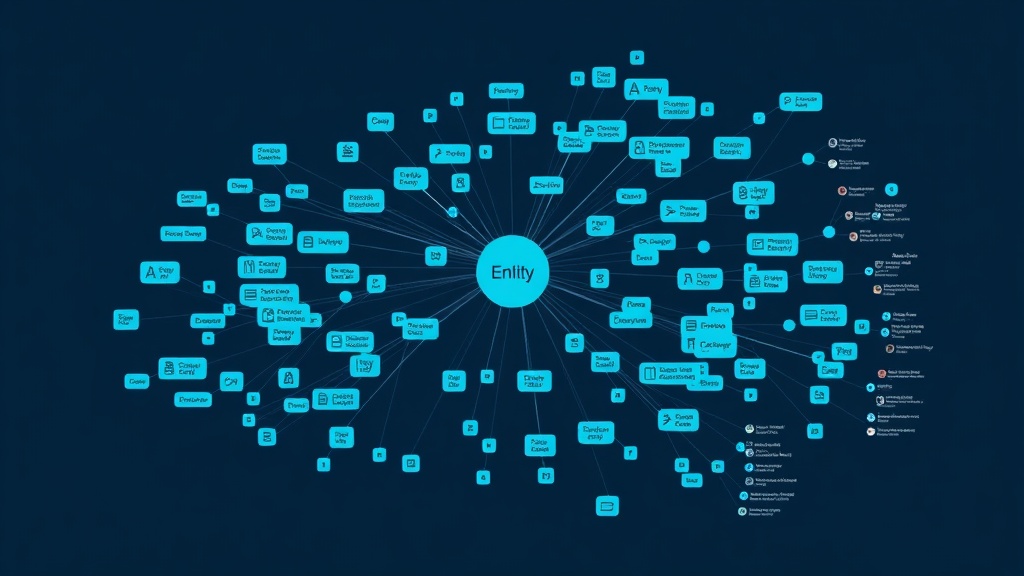
Google doesn't just index web pages anymore, it understands entities. An entity is a distinct, well-defined thing: a person, a place, an organization, a concept. When Google recognizes your business as an entity with clear attributes (location, services, industry, relationships to other entities), it can serve your business as an answer to queries with much higher confidence. Entity SEO is the practice of making your business a clearly defined, well-connected entity in Google's Knowledge Graph.
For local businesses, entity SEO is increasingly important because both Google's traditional algorithm and its AI search surfaces rely on entity understanding to generate results. When Google confidently knows what your business is, where it's located, what services it provides, and how it relates to other known entities, it's far more likely to recommend your business, in blue links, in the Map Pack, and in AI Overviews.
What Is an Entity in Google's Knowledge Graph?
Google's Knowledge Graph is a massive database of entities and the relationships between them. Your business is an entity. Your city is an entity. Your industry is an entity. The services you provide are entities. Entity SEO is about ensuring Google correctly understands your business entity and its relationships to all the other entities that define your market relevance.
A strong local business entity has: a consistent name across all web properties, a verified physical or service area, clearly defined service categories, connections to known industry and location entities, consistent citations on trusted directories, structured data that explicitly defines entity properties, and authoritative content that demonstrates expertise. Each of these signals helps Google build a more complete and confident understanding of your business.
How Entity Signals Differ From Traditional SEO Signals
| Signal Type | Traditional SEO | Entity SEO |
|---|---|---|
| Keywords | Target specific search phrases | Define concepts and relationships between entities |
| Links | Build backlinks for page authority | Build connections between entities (co-citations, mentions) |
| Content | Optimize pages for individual keywords | Build [topical authority](/blog/topical-authority-local-seo) that defines the entity's expertise |
| Structured Data | Use schema for rich snippets | Use schema to explicitly define entity properties and relationships |
| Local Signals | NAP consistency for citations | Entity reconciliation across all platforms and Knowledge Graph sources |
Building Your Business Entity
Entity Foundation Checklist
- Claim and fully optimize your Google Business Profile, this is your primary entity definition in Google's ecosystem
- Implement Organization and LocalBusiness schema on your website with @id, sameAs, and areaServed properties
- Create or claim your Wikipedia article (if notable enough) or Wikidata entry, these are primary Knowledge Graph sources
- Ensure your business name, address, and identifiers are identical across every web property (website, GBP, social profiles, directories)
- Build sameAs connections: link your website to your GBP, social profiles, and directory listings using schema sameAs property
- Publish an About page that clearly defines your business entity: founding date, founders, services, locations, industry, and credentials
- Create service pages that define each service as a distinct entity with connections to your business entity and location entities
Entity Relationships for Multi-Location Businesses
For multi-location businesses and franchises, entity SEO adds another layer: each location is its own entity with a relationship to the parent brand entity. Google needs to understand that 'Brand Name - Dallas' and 'Brand Name - Houston' are distinct entities (each serving a different market) that share a parent entity (the brand). Schema markup using Organization → subOrganization or Organization → department relationships makes this hierarchy explicit.
Without clear entity relationships, Google may confuse your locations, merge listings, or fail to rank individual locations in their respective markets. This is one of the most common and most damaging issues in multi-location GBP management. Proper entity SEO prevents it by giving Google an unambiguous structure to work with.
Co-Citations and Entity Association
Co-citation occurs when your business is mentioned alongside other known entities on third-party websites, without a direct link. When a local news article mentions your business in the same context as your city, your industry, and your competitors, Google uses those co-citations to strengthen its understanding of your business entity and where it fits in the local market. This is why PR, local news coverage, and community involvement are powerful entity SEO signals, even when they don't include a backlink.
Structured Data Implementation for Entity SEO
Schema markup is how you explicitly tell Google about your entity and its properties. For local businesses, the key schema types are LocalBusiness (or a more specific subtype like Plumber, Dentist, or LegalService), Organization (for the parent brand), and Service (for each service offered). Each schema instance should include @id (a unique identifier, typically a URL), sameAs (links to other representations of the entity), and areaServed (the geographic areas served).
Test your entity definition by searching for your business name in Google. If a Knowledge Panel appears on the right side of search results, Google recognizes your business as an entity. If no panel appears, your entity signals need work. Use the structured data testing tool to verify your schema implementation, and check Google's entity understanding through the Knowledge Graph Search API.
Entity SEO and AI Search
Entity SEO becomes even more important in the age of AI-powered search. When ChatGPT, Perplexity, or Google AI Overviews answer a question like 'What's the best roofing company in Phoenix?', they're not matching keywords. They're identifying entities that match the query criteria. Businesses with strong entity signals, clear identity, verified attributes, authoritative content, and well-connected entity relationships, are far more likely to be recommended by AI search engines than businesses that are just optimized for keywords.
Frequently Asked Questions
What's the difference between entity SEO and regular local SEO?
Traditional local SEO focuses on optimizing for specific search queries (keywords). Entity SEO focuses on making your business a clearly defined entity that Google understands independently of any specific query. Think of it this way: local SEO helps you rank for 'plumber in Dallas.' Entity SEO helps Google understand that your business IS a plumber in Dallas, which helps you rank for every related query, including ones you haven't specifically optimized for.
How do I check if Google recognizes my business as an entity?
Search for your exact business name in Google. If a Knowledge Panel appears on the right side of search results (desktop) with your business information, Google recognizes you as an entity. You can also use the Google Knowledge Graph Search API to query for your business. If you're not recognized as an entity yet, focus on consistent NAP data, structured data implementation, and building citations on authoritative platforms.
Can entity SEO help a new business with no online presence?
Entity SEO is especially valuable for new businesses because it helps Google rapidly understand what your business is and how to categorize it. Start by creating your Google Business Profile, implementing comprehensive schema markup on your website, building citations on the top 20 directories, and creating a thorough About page. These foundational entity signals help Google index and categorize your business much faster than keyword optimization alone.
Do I need a Wikipedia page for entity SEO?
No. A Wikipedia page helps, but it's not necessary for local entity SEO. Google draws entity information from many sources: your GBP profile, your website's structured data, Wikidata entries, major directory listings, and authoritative mentions across the web. For most local businesses, a complete GBP profile, proper schema markup, and consistent citations are sufficient to establish entity recognition.

Written by
Jason JacksonChief Operating Officer, Locafy Limited
COO at Locafy (Nasdaq: LCFY). Builds and operates AEO systems for local businesses. Founded Growth Pro Agency before joining Locafy via acquisition.