
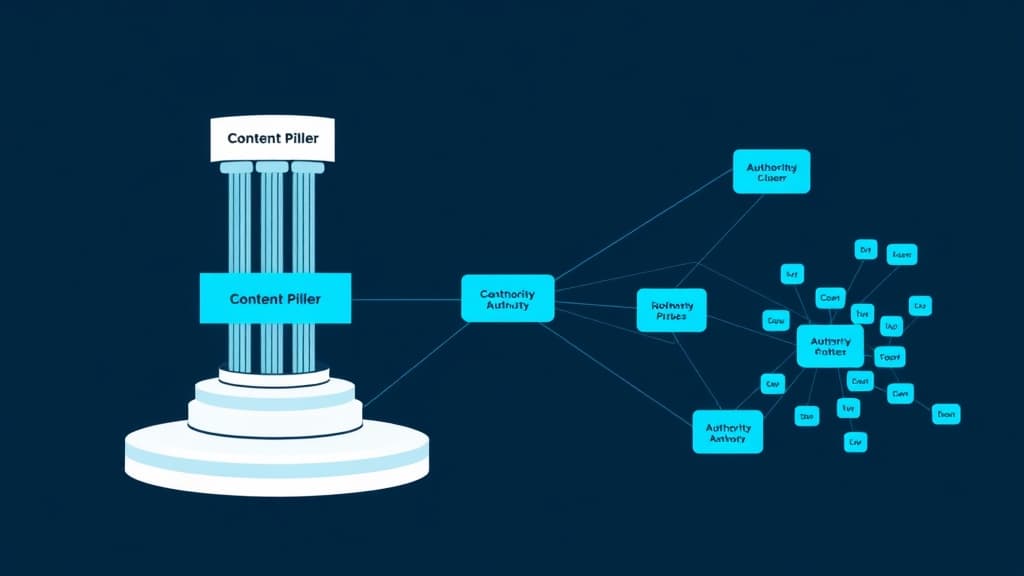
Topical authority is the concept that Google trusts websites more when they demonstrate deep, comprehensive expertise on a subject, not just surface-level coverage. For local businesses, topical authority means becoming the definitive online resource for your services in your market. When a website covers a topic from every angle, beginner guides, technical deep-dives, FAQs, case studies, and related subtopics, Google treats it as the authoritative source and rewards it with higher rankings across all related queries.
This isn't theoretical. Google's search quality guidelines explicitly mention E-E-A-T (Experience, Expertise, Authoritativeness, Trustworthiness) as evaluation criteria. Entity SEO builds the connections; topical authority fills them with substance. Together, they create a content foundation that performs in both traditional search and AI-powered answer engines.
What Topical Authority Looks Like for Local Businesses
A local plumber with a 5-page website covering 'plumbing services,' 'about us,' 'contact,' and two blog posts has no topical authority. A local plumber with 50+ pages covering every plumbing service, water heater guides, pipe material comparisons, DIY troubleshooting articles, local plumbing code explanations, and seasonal maintenance checklists has significant topical authority. Google sees the second website as the expert, and ranks it accordingly.
For multi-location businesses, topical authority is built at the brand level and distributed to all locations. The pillar content lives on the main domain, serving all markets, while location-specific content adds local relevance signals. This two-tier approach is more efficient than having each location build topical authority independently, and it creates a competitive moat that single-location competitors struggle to match.
Building Content Clusters for Local Topics
A content cluster consists of a pillar page covering a broad topic and multiple supporting pages covering subtopics in depth. For a local roofing company, the pillar might be 'Complete Guide to Roof Replacement' with supporting pages on materials (asphalt shingles vs. metal vs. tile), costs, timeline, insurance claims, permits, and seasonal considerations. Each supporting page links to the pillar, and the pillar links to each supporting page.
Content Cluster Architecture
- Pillar page: comprehensive guide covering the topic at 2,000+ words with links to all supporting pages
- Supporting pages: focused articles on subtopics at 800-1,500 words each, linking back to the pillar
- FAQ pages: collections of common questions that users ask, targeting featured snippet opportunities
- Case studies: real-world examples demonstrating expertise with specific, measurable results
- Location-specific content: applying the topical framework to each service area with local details
- Cross-cluster links: connecting related clusters to build site-wide topical coherence
The Role of Semantic Depth
Semantic depth means covering a topic thoroughly enough that your content answers not just the primary query, but all related queries a searcher might have. Google's natural language processing models evaluate whether content addresses a topic comprehensively or just skims the surface. Content with semantic depth uses relevant terminology, covers edge cases, addresses counterarguments, and provides specific, actionable information rather than generic advice.
For local businesses, semantic depth includes local knowledge: specific regulations in your market, regional terminology customers use, local pricing context, and references to local conditions that affect your services. A roofing company in Dallas that discusses Texas wind and hail damage requirements, DFW-specific insurance processes, and references to local building codes demonstrates deeper expertise than one that publishes generic roofing content.
How Topical Authority Feeds AI Search
Topical authority isn't just a traditional SEO play. AI search engines like ChatGPT, Perplexity, and Google AI Overviews rely on identifying authoritative sources to generate their answers. When your website is the most comprehensive resource on a topic in your market, AI systems are more likely to cite you in their responses. This is the convergence of SEO and AEO, and topical authority is the foundation of both.
AI search engines don't just look at individual pages, they evaluate entire domains for expertise signals. A website with 3 pages about HVAC repair will almost never be cited by an AI search engine. A website with 40 pages covering every aspect of HVAC for a specific market becomes a source that AI systems actively reference. Build depth, not just breadth.
Measuring Topical Authority
Topical authority isn't a metric you can pull from a dashboard, it's an emergent property of your content strategy. However, you can measure its effects through proxy metrics: the number of keywords your site ranks for within a topic cluster, the average ranking position for those keywords, the percentage of featured snippets you hold for related queries, and whether your content is being cited by AI search engines. Track these in your local SEO reporting setup and look for upward trends across the cluster, not just individual pages.
Common Mistakes That Undermine Topical Authority
- Publishing thin blog posts (under 500 words) that add pages without adding depth
- Creating content on unrelated topics that dilutes your site's topical focus
- Not linking between related content, isolated pages can't build cluster authority
- Writing for search engines instead of for users, keyword-stuffed content that lacks genuine expertise
- Neglecting content updates, outdated information undermines trust and authority signals
- Ignoring entity SEO, topical authority without entity clarity leaves Google uncertain about who the authority is
- Not building a content strategy before writing, random blog posts don't create coherent authority
Frequently Asked Questions
How many pages do I need to build topical authority?
There's no minimum number, but research suggests that content clusters with 15-25 supporting pages around a pillar topic begin to show significant ranking advantages. Quality matters more than quantity, 20 well-researched, substantive pages outperform 50 thin ones. For local businesses, aim to cover every service, every FAQ, and every aspect of your expertise with dedicated pages.
How long does it take to build topical authority?
Expect 6-12 months of consistent content publication before topical authority signals meaningfully impact rankings. The timeline depends on your starting point (existing content), publication frequency, content quality, and competitive landscape. Businesses that publish 4-8 substantive pieces per month typically see the inflection point faster than those publishing monthly.
Can a small local business build topical authority against national brands?
Absolutely, and it's actually easier at the local level. National brands build broad authority, but they rarely build deep authority in a specific market. A local HVAC company that covers every aspect of HVAC service in Dallas, including local codes, climate-specific advice, and neighborhood-level pricing, builds more local topical authority than a national brand with generic content. Local depth beats national breadth for local queries.
Does topical authority help with Google Map Pack rankings?
Indirectly, yes. Google's local algorithm considers the relevance and authority of the website linked to a Google Business Profile. A website with strong topical authority sends a powerful relevance signal that can boost Map Pack positions. This is especially important for competitive markets where GBP signals alone aren't enough to differentiate.

Written by
Jason JacksonChief Operating Officer, Locafy Limited
COO at Locafy (Nasdaq: LCFY). Builds and operates AEO systems for local businesses. Founded Growth Pro Agency before joining Locafy via acquisition.